*****
Judges Explain Alternatives to Incarceration
This panel presentation explores the tools judges employ to protect the community while
reducing reliance on sentences of incarceration. The panel will delve into the use of probation,
specialty courts, restorative justice, and other strategies available to encourage prosocial conduct,
protect the public, and hold offenders accountable. The presentation will feature a diverse panel
of judges, who will provide insights from different courts in Hamilton County. One of the goals
of the Collaborative Agreement was to promote public safety while reducing arrests and
incarceration through problem-solving and other tools such as the ones that this panel will explore.
Panel
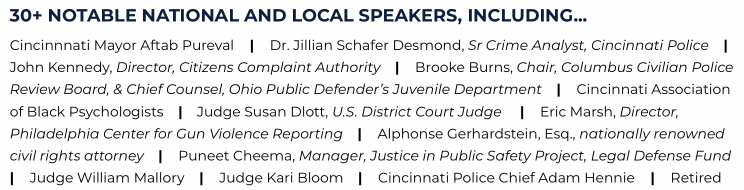
Judge Kari Bloom was elected in 2020 to serve on the Hamilton County Juvenile Court for six years beginning on February 14, 2021. On January 1, 2023, she became the
administrative judge, overseeing the day-to-day running of the Juvenile Court. Before her
election, Judge Bloom served in the Office of the Ohio Public Defender. In the office, she served
as a legislative liaison and parole attorney and testified in the Ohio House of Representatives and
Senate on behalf of juvenile justice issues, including alternatives to incarceration. She also
investigated, prepared, and represented citizens in front of the Ohio Parole
Board. Judge Bloom was also an attorney in the Hamilton County Public Defender’s Office. She
earned her bachelor’s degree from Bowling Green State University in 2008 and J.D. from the
University of Cincinnati, College of Law in 2011.
Judge William L. Mallory. Judge William Mallory graduated as valedictorian from Taft High
School of Cincinnati in 1976. He graduated from the University of Cincinnati with a
degree in Political Science in 1981. He earned his Juris Doctor from Salmon
P. Chase College of Law in 1986.
After graduation from law school, he began his legal career as an Assistant Attorney General for
the State of Ohio. Judge Mallory later became an Assistant Prosecuting Attorney for the City of
Cincinnati. In 1989, William left public service and went into private law practice with the labor
law firm of Kircher and Phalen. William worked in the areas of criminal law, personal injury,
probate, business law, liquor law, administrative law, juvenile, and family law.
In 1993, William was elected Judge on the Hamilton County Municipal Court. He served until
2006. Judge Mallory also served on the Board of Trustees of the Association of the
Municipal/County Judges of Ohio. He also served as president of the Chase Law School Alumni
Association.
William Mallory was elected to the Hamilton County Court of Common Pleas in 2006. He
served there until he was appointed as the first African-American judge on the Hamilton County
First District Court of Appeals of Ohio. Judge Mallory was elected to the Hamilton County
Municipal Court in 2011.
He currently serves on the Board of Directors of the Dan Beard Council of the Boy Scouts of
America. William has served as a judge of the Jack Grosse Moot Court competition at Chase
Law School in 2011, 2012, and 2013. He also served on the panel for the selection of the Harry S.
Truman Foundation 2011, 2012 and 2013 Award recipients for Ohio, Kentucky, and Indiana. He
is a member of the American Judges Association and the Association of County/municipal
Judges of Ohio.
Alphonse Gerhardstein, Esq., is a Partner at Friedman, Gilbert + Gerhardstein and is a
nationally renowned civil rights attorney. Gerhardstein has successfully litigated many police
abuse and criminal reform cases in his career. He represented the Cincinnati Black United Front
when the Collaborative Agreement was established. Al led class actions challenging health care
in Ohio’s prison system and successfully secured reductions in thousands of sentences on
behalf of a class of prisoners improperly ordered to serve post-release control in Ohio.
Additionally, along with the Children’s Law Center, he secured extensive reforms for youth
committed to the Ohio Department of Youth Services, closing five facilities and reducing the
population from 2,200 youth to an average of 450.
Notably, in his gay rights work, Gerhardstein was lead counsel in Obergefell v. Hodges, the 2015
U.S. Supreme Court case establishing equality for same-sex couples in all 50
states. Gerhardstein has been interviewed and quoted extensively in national and Ohio media and
has taught civil rights litigation at Northern Kentucky University and the University of
Cincinnati law schools. Gerhardstein has a bachelor’s degree from Beloit College in Wisconsin
and a J.D. from New York University School of Law.
********
Brooke M. Burns is Managing Counsel of Youth Defense at the Ohio Public Defender. A Cincinnati native, Brooke joined the OPD in 2006 and over her litigation career represented hundreds of children and teenagers in Ohio’s youth and criminal legal systems. She successfully litigated six cases in the Supreme Court of Ohio, which resulted in strengthening due process rights for children in Ohio. In her current role, Brooke engages in policy reform, advocating and partnering with other youth justice advocates, nonprofit organizations, colleges, universities, and other state agencies to improve access to justice for children, conditions of confinement for youth, and reduce the impact of racial and ethnic disparities in the youth legal system. In addition, Brooke has served the community as a member of the Governor’s Council on Juvenile Justice, the Ohio Criminal Sentencing Commission, Ohio’s JDAI State Leadership Committee, the Columbus Community Safety Advisory Commission, the Lower Lights Christian Health Center Board, and the Columbus Police Civilian Review Board, which she chairs. Brooke serves the broader youth defender community as a member of the Gault Center’s National Advisory Board and a Co-Director of the Gault Center’s Great Lakes Regional Advisory Board. In addition, Brooke is an adjunct professor of Juvenile Law at Capital University School of Law.
Kenneth L. Lawson is Co-Director of the Hawaiʻi Innocence Project and a tenured
professor at the William S. Richardson School of Law, University of Hawaiʻi at Mānoa,
where he teaches Evidence, Criminal Law, and Criminal Procedure.
Kenny began his career at Taft, Stettinius & Hollister, the first Black lawyer at the firm.
In 1993 he left to take over the Cincinnati practice of Leslie Isaiah Gaines, Jr. — the
Howard-trained trial lawyer, broadcaster, and later Hamilton County judge whose office
had launched a generation of the city’s Black attorneys — and Kenny continued that
tradition. Over eighteen years he was lead counsel in more than a hundred criminal trials
and represented dozens of Black, brown, and white families who had lost unarmed loved
ones in police custody. His clients also included NFL and Major League Baseball star
Deion Sanders and Bengals fullback Elbert “Ickey” Woods. Roughly a fourth of his
caseload was pro bono. His firm helped bring the racial profiling suit that produced the
federally enforceable Collaborative Agreement, and he represented the Cincinnati Black
United Front in the negotiations.
He later lost his law license and was sentenced to serve twenty-four months in federal
prison on a felony conviction arising from an addiction to prescription painkillers — a
history he speaks about openly and that shapes how he teaches accountability and second
chances.
As Co-Director of the Hawaiʻi Innocence Project, Kenny worked alongside Barry Scheck
of the Innocence Project and renowned forensic genetic genealogist Steve Kramer — the
former FBI counsel who assembled and led the team that identified the Golden State
Killer — not only to exonerate Ian and Shawn Schweitzer, wrongly convicted of the 1991
murder of Dana Ireland, but to identify the man who actually killed her. Ian had spent 25
years in prison. The Project’s work also freed Gordon Cordeiro in 2025 after 30 years in
prison for a 1994 Maui killing he did not commit. Kenny co-authored Hawaiʻi’s wrongful
conviction compensation statute and helped secure the state supreme court decision
interpreting it.
He co-founded Beyond Guilt Hawaiʻi — modeled on the Ohio Justice and Policy
Center’s clinic, the first outside Ohio — which handles clemency, compassionate release,
parole, and record clearing, and he represents the Innocence Project on Hawaiʻi’s Clean
Slate Expungement Task Force. In spring 2026 he presented on forensic genetic
genealogy with Scheck and Kramer in Chicago.
The law school’s Classes of 2014 and 2018 chose him to deliver their graduation address,
and he received the Board of Regents’ Excellence in Teaching Award. He serves on the
boards of the ACLU of Hawaiʻi and the Innocence Network.
************
Mark Manning is currently the Chief Counsel for the City Solicitor’s Office Quality of Life team, which handles nuisance enforcement with the City of Cincinnati. The Quality of Life team coordinates Cincinnati’s Code Enforcement Response Team, drug house abatement, enforcement of the City’s chronic nuisance ordinance for multi-family properties, sex offender residency, liquor license enforcement, and the Place-based Investigations of Violent Offender Territories (PIVOT) team, which won the prestigious 2017 Herman Goldstein Award. Since starting at the City in 2012, Mark has prosecuted and supervised hundreds of cases involving problem businesses and substandard housing conditions that impact tens of thousands of Cincinnati residents. Mark earned his B.A. from Xavier University in 2008 and J.D. from The Ohio State University in 2011.
********
Judge Susan J. Dlott has presided in the Southern District of Ohio since she was
appointed by President Clinton in 1995. In her thirty years on the bench, she is best known for
achieving a collaborative settlement agreement between the Cincinnati Police Department and
community groups following a period of civil unrest in Cincinnati, Ohio in the early 2000s.
She says that the most challenging, but most important, duty of her position is sentencing
criminal defendants. Judge Dlott is appreciated for carefully considering the seriousness of the
crime and the individual circumstances of each defendant at the time of sentencing. As her
judicial portrait reflects, she is well known for her love of Cavalier King Charles spaniels.
Judge Dlott was born and raised in Dayton, Ohio. After receiving her B.A. from the
University of Pennsylvania in 1970, she graduated from Boston University School of
Law in 1973.
Upon graduation, she clerked for Judges Jack G. Day and Alvin J. Krenzler of the Ohio Court of
Appeals in Cleveland, Ohio. She then served in the Southern District of Ohio as an Assistant
United States Attorney from 1975–1979. Her duties included both civil and criminal litigation.
She entered private practice with the Cincinnati law firm of Graydon, Head & Ritchey and, in
1981, she became its first female partner. During her sixteen-year tenure at the law firm, Judge
Dlott litigated on behalf of both plaintiffs and defendants in high-profile civil and white-collar
criminal cases. She garnered an acquittal for one client in the then-longest criminal trial held in
Hamilton County, Ohio; was court-appointed lead counsel in a fifty-nine-defendant securities
fraud case; and was court-appointed lead counsel for a subclass of plaintiffs in Bendectin
litigation.
In 1995, she was appointed to the federal bench, which marked the beginning of the most
fulfilling chapter of her legal career. Judge Dlott has served as a District Judge in the Southern
District of Ohio since 1995, presiding primarily in Cincinnati. She was Chief Judge from 2009–
2014. A summary of some of Judge Dlott’s noteworthy cases is separately listed.
Judge Dlott is a member of the Federal Bar Association, the Ohio Bar Association, and the
Cincinnati Bar Association. She is past President of the Potter Stewart Inn of Court, was a life
member of the Sixth Circuit Judicial Conference before her appointment to the bench, and
served as an instructor in the Trial Advocacy Workshop at Harvard Law School. Judge Dlott has served on numerous boards including the Dayton and Cincinnati Federal Bar Associations, the Ohio Building Authority, Cincinnati Arts Association, Jewish Federation of Cincinnati, the
YWCA, Summer Work Experience in Law (SWEL), and Cincinnati Public Radio. She is an
alumna of Leadership Cincinnati and a member of the Queen City Dog Training Club Inc.
Judge Dlott has received numerous awards for her career of service to the community and in the law. She is the recipient of the Service Award, Dayton Bar Association, 1975–1976; YWCA
Career Woman of Achievement, 1996; Cincinnati Women Honoree, 1998; Downtown Residents’ Council Community Service Gift of Appreciation Award, 2000; the Cincinnati NAACP Fair and Courageous Award, 2006; and the YWCA Racial Justice Award, February 2008. Most recently, in 2023, the Cincinnati Bar Foundation presented Judge Dlott with the John L. Muething Lifetime Achievement in Law Award. The honor is presented for more than 50 years of exemplary service as a lawyer. Through her distinguished career, she has reflected the highest principles and traditions of the legal profession.
********