The Cincinnati Collaborative Agreement: A History
A City Under Pressure
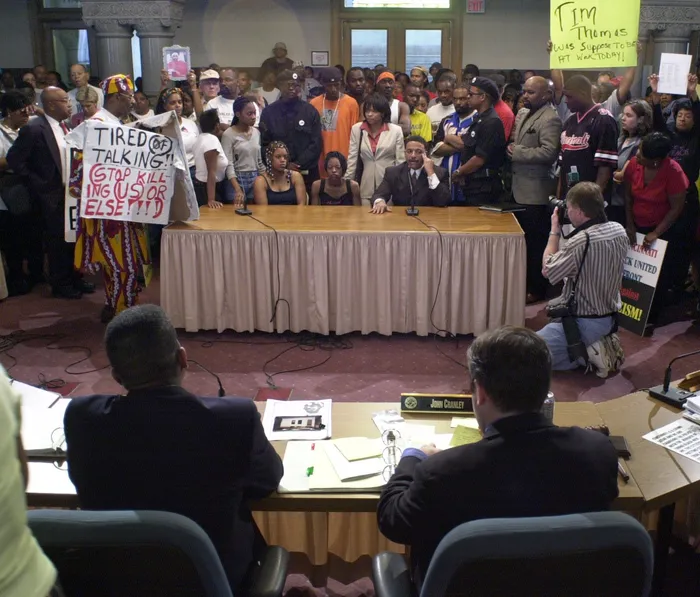
By 2001, Cincinnati’s Black community and its police department had spent years accumulating grievances and distrust on both sides. Fifteen Black men had been killed in encounters with Cincinnati police since 1995, four of them in the seven months before that April. The department was about 20 percent Black at the time, and some officers involved in the fatal shootings were Black themselves — a fact that complicated the easy story but changed nothing about how the deaths felt to the people living through them.
The legal fight had already started before the event that everyone remembers. Two weeks before Timothy Thomas was killed, a coalition led by the Cincinnati Black United Front and the ACLU of Ohio sued the city, charging the police department with racially biased patterns of policing and violence. Then, in the early hours of April 7, 2001, Officer Stephen Roach shot and killed nineteen-year-old Timothy Thomas in an alley in Over-the-Rhine. Thomas was unarmed. Roach had been trying to arrest him over a stack of nonviolent misdemeanor warrants, mostly traffic citations. He was the fifteenth Black man killed by Cincinnati police in six years, and that number is what broke the city open.
Four days of unrest followed, starting with a demonstration at City Hall and spreading into rioting concentrated in Over-the-Rhine. Between April 9 and April 13, the disorder caused an estimated $3.6 million in damage to 120 businesses and public buildings — the worst urban unrest the country had seen since the Rodney King riots in Los Angeles nine years earlier. Mayor Charles Luken declared a state of emergency and put the city under curfew; the governor sent in state troopers, and more than 800 people were arrested for curfew violations alone. It ended, notably, without more violence: on April 14, the day Timothy Thomas was buried, over 2,000 people marched through Cincinnati’s streets peacefully.
None of this happened in a vacuum. Cincinnati’s history includes earlier episodes of racial violence that organizers and historians still draw a line to — a white mob drove roughly a thousand Black residents out of the city in 1829, and in 1841 an armed mob fired a cannon into a Black neighborhood, killing several people. Seen against that backdrop, 2001 read less like an aberration and more like the same old wound reopening.
How the Lawsuit Became a Settlement
The response moved fast once Thomas was killed. The NAACP joined the existing lawsuit, and the city agreed to mediation by May 2, 2001. What eventually came out of that mediation named the City of Cincinnati, the Fraternal Order of Police, the ACLU of Ohio, and the Cincinnati Black United Front as parties, settling the claims brought by plaintiff Bomani Tyehimba and others. The process wasn’t just lawyers in a room — a nine-month public process ran through 2001, and residents specifically pushed the city to expand community-oriented policing. About 3,500 people took part in visioning and goal-setting sessions, and the federal court later adopted their recommendations as enforceable terms.
Negotiations dragged on for months alongside those community forums, and a final settlement came together in April 2002, with the judge signing off that August. The agreement was signed April 11, 2002, by the city, its police officers, and its citizens.
What the Agreement Actually Said
Three ideas anchored the agreement: that the underlying conflict came from something much bigger than police-community relations alone, that most of it could be worked through with careful, evidence-based problem-solving, and that success would be measured by whatever Cincinnati’s own residents said counted as success. It ran for an initial five years and laid out clear goals — police and residents as partners in solving neighborhood problems, real trust between the two, better training and hiring and accountability inside the department, and fair, courteous treatment for everyone.
It also built machinery to make those goals stick. The agreement set up an independent Citizen Complaint Authority to hear misconduct allegations. It called for a coordinating body to be stood up within thirty days of court approval, to consult on and support implementation across every party involved. Saul Green was brought on as the court-appointed monitor for the following five years, working alongside the city and community partners on evaluation and accountability. Federal supervision lasted until August 2008, when the city, police department, and community partners replaced it with their own Collaborative Agreement Plan and created the City Manager’s Advisory Group to keep watching over the work.
What It Left Behind
Cincinnati’s agreement got noticed well beyond Ohio. Once the federal court approved it, other cities started looking at it as a model for their own reform efforts. In the years afterward, tens of millions of dollars went into changing how the department operated, a community-based Police-Community Partnering Center opened, and the city hired its first African American police chief.
The agreement hasn’t been left to gather dust, either. In June 2017, the city voluntarily launched a “Collaborative Agreement Refresh,” bringing Saul Green back to focus on bias-free policing, officer accountability, and mutual accountability among the original parties. That work took on new weight after 2020. George Floyd’s killing pulled national attention back to Cincinnati and reignited local debate over police funding and tactics; Mayor Aftab Pureval repeatedly reaffirmed the city’s commitment to the agreement after taking office. In February 2022, Pureval announced a partnership with Iris Roley, a founder of the Cincinnati Black United Front, to lead community engagement and carry the agreement’s mission forward. That April, the city marked the agreement’s twentieth anniversary with public forums looking back at its history and the changes to community policing over the two decades since.
More than twenty years on, the Collaborative Agreement is still being argued over, revised, and reaffirmed. It’s not a plaque on a wall — it’s the ongoing answer, still being written, to one terrible week in April 2001.
Bibliography
ACLU of Ohio. “The Cincinnati Collaborative Agreement.” Accessed August 12, 2026. https://www.acluohio.org/news/cincinnati-collaborative-agreement/.
BlackPast.org. “The Cincinnati Riot (2001).” Last modified March 3, 2025. https://blackpast.org/african-american-history/the-cincinnati-riot-2001/.
City of Cincinnati. “Collaborative Agreement Refresh.” Accessed August 12, 2026. https://www.cincinnati-oh.gov/police/collaborative-agreement-refresh/.
City of Cincinnati. “Collaborative Agreement Timeline.” Accessed August 12, 2026. https://www.cincinnati-oh.gov/police/collaborative-agreement-refresh/documents-and-media-resources/collaborative-agreement-timeline/.
City of Cincinnati. “Collaborative Settlement Agreement.” April 11, 2002. https://www.cincinnati-oh.gov/sites/ccia/assets/File/Collaborative%20Agreemnet.pdf.
EBSCO Research Starters. “Cincinnati Riots of 2001.” Accessed August 12, 2026. https://www.ebsco.com/research-starters/history/cincinnati-riots-2001.
Mediate.com. “The Cincinnati Police-Community Relations Collaborative as a National Model for Improving Police-Community Relations Today.” June 19, 2015. https://mediate.com/the-cincinnati-police-community-relations-collaborative-as-a-national-model-for-improving-police-community-relations-today/.
Oxford African American Studies Center. “Cincinnati Race Riots of 2001.” Accessed August 12, 2026. https://oxfordaasc.com/display/10.1093/acref/9780195301731.001.0001/acref-9780195301731-e-78142.
Spectrum News 1. “Cincinnati Marks 20 Years of Historic Collaborative Agreement.” April 13, 2022. https://spectrumnews1.com/oh/columbus/news/2022/04/12/cincinnati-20th-anniversary-collaborative-agreement.
University of California, Irvine (Social Science site, hosting “Improving Police-Community Relations in Cincinnati: A Collaborative Approach”). Accessed August 12, 2026. https://sites.socsci.uci.edu/~pgarb/istudies/applied/presentations/site/media/printarticles/wy7-p.html.
University of Wisconsin–Madison, Race, Politics, and Justice Blog. “Cincinnati 2001: Police Killing of Timothy Thomas and Insurrection.” Accessed August 12, 2026. https://www.ssc.wisc.edu/soc/racepoliticsjustice/2024/01/19/cincinnati-2001-police-killing-of-timothy-thomas-and-insurrection.
WCPO 9. “Timothy Thomas, Civil Unrest and a Quest for Equality: Where Are We Now?” April 11, 2021. https://www.wcpo.com/news/local-news/timothy-thomas-civil-unrest-and-a-quest-for-equality-where-are-we-now.
Wikipedia. “Cincinnati Riots of 2001.” Accessed August 12, 2026. https://en.wikipedia.org/wiki/Cincinnati_riots_of_2001.